ARTICLE
Threads of the Andes: the weaving tradition of Chinchero
30.03.26
/
15 min.
by
Federico Maggi
Share Article
In a small courtyard in Chinchero, a family quietly keeps an ancient language alive — one made of wool, color, and memory
High in Peru’s Sacred Valley, about an hour from Cusco, sits Chinchero, a charming village mainly renowned for its ancient Inca ruins and what is said to be one of the most authentic artisanal markets in the region. Here, locals meet every Sunday to sell the handcrafts they produced during the week and enjoy a warm chicken soup (or a deep-fried guinea pig, if you fancy it) in good company.
For countless generations — I was told — the women of Chinchero have been among the most skilled weavers in the Andes, perhaps even in the world. Their techniques trace back to the time of the Incas, and possibly much further. What I wasn’t told, and which I learned that day, is that what they produce isn’t simply fabric, but something closer to a language: one made of symbols, landscapes, animals, heritage and stories, all slowly woven into wool.
I have to say, getting there was already quite the experience.
From Cusco I hopped on two different colectivos, the small shared vans that work as public transport across much of Peru, all for a mere Peruvian sol each (currently around 25 cents). Tightly squeezed among locals of all ages, the road wound through the hills, climbing gradually past fields and scattered houses, with mountains standing quietly in the background as they have for millions of years. The kind of journey where you feel a quiet excitement simply because you are going somewhere unfamiliar.
By then, I had only exchanged a brief WhatsApp message with Karen — the daughter of the weaving family I planned to visit — whose contact had been given to me by a kind Brazilian lady I had met during a trek in the Cordillera Blanca. So, although I had a location pinned on my phone, I still carried that sweet feeling of uncertainty that often accompanies travel.
When I arrived, the place looked fairly ordinary, at least by Peruvian standards. Dusty gravel roads stretching between low unfinished buildings, stray dogs sleeping wherever the sun feels warmest, and a structure that looked more like an old spare-parts warehouse than any sort of cultural space. I checked the location on my phone again and again, and smiled slightly at the ambiguity of it all.
A cigarette and a few minutes later, a tiny door patched up with some old corrugated aluminium panels opened.
A very short woman stepped out wearing traditional Andean clothing: a layered pollera skirt, an embroidered jobona jacket, and a montera hat resting proudly on her head. It was Karen.
“Allillanchu!” (Quechua for “welcome”, like my broken Spanish wasn’t already making it hard enough to communicate back then), she said with the biggest smile on her face — one of those extremely contagious ones, with signs of kindness written all over it.
Only then did I really notice the door she had come through. It couldn’t have been much taller than a metre, maybe even less, considering that even she — not quite a giant, to be honest — had to do what seemed like a curtsy squat in order to pass through. Not without difficulty, I then proceeded to do the same, which somehow felt like a fitting gesture for the sacred realm I was about to enter.
Inside, the room was bursting with colour: blankets, socks, scarves, and woven bags filling the space in all kinds of tints. Hundreds of patterns covered the fabrics, each one slightly different from the next. Karen explained that these designs are called pallay, and they carry meaning rooted in Inca tradition. Many represent elements of the Andean world: mountains, animals, rivers, plants, or agricultural cycles and tools. What might appear decorative to an outsider is, in reality, a beautiful form of storytelling.
After letting me gaze in awe at that dreamy kaleidoscope of colours for a few good minutes, Karen finally brought me back to reality by leading me through the back of the building, into a small courtyard where her parents were preparing the demonstration.
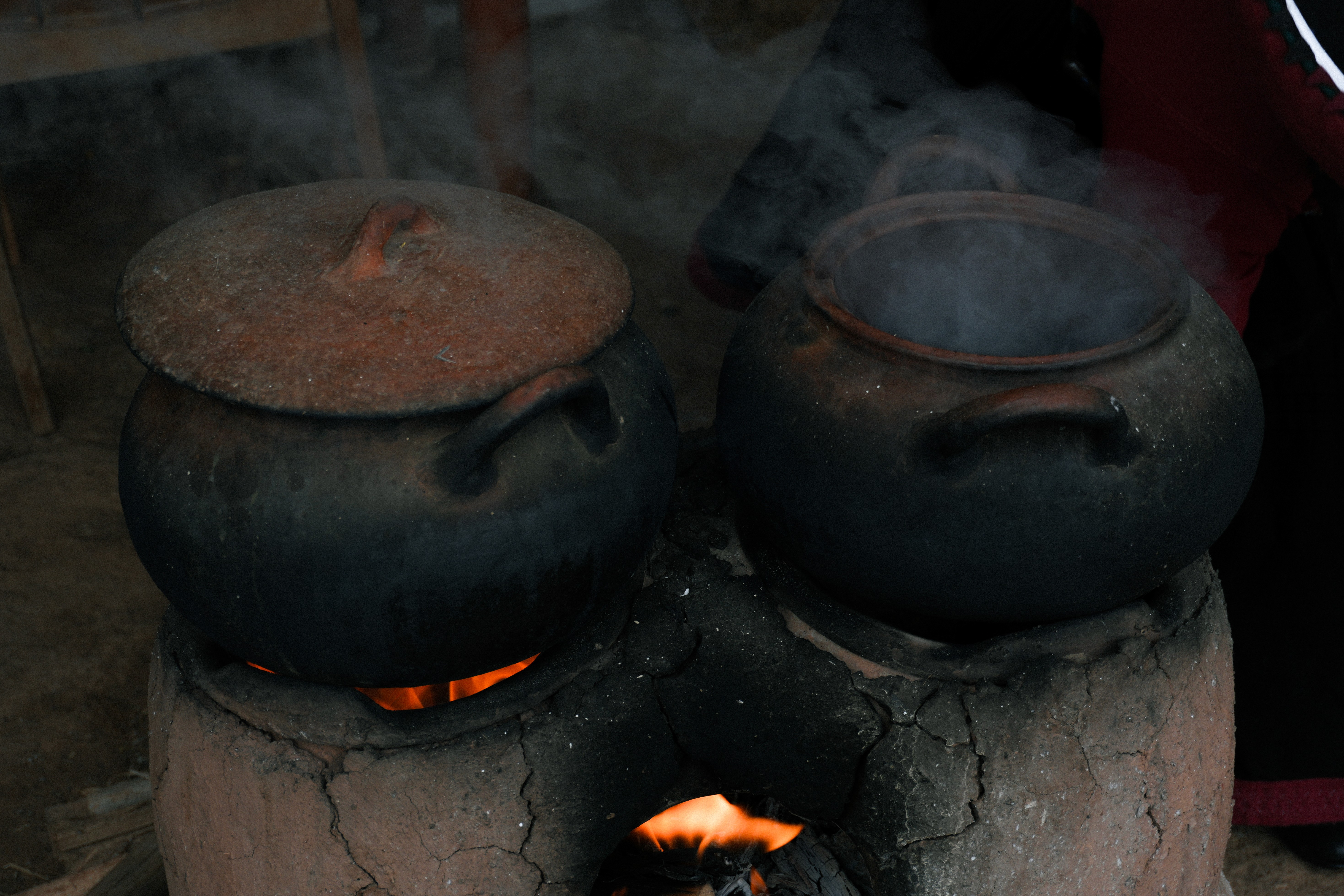
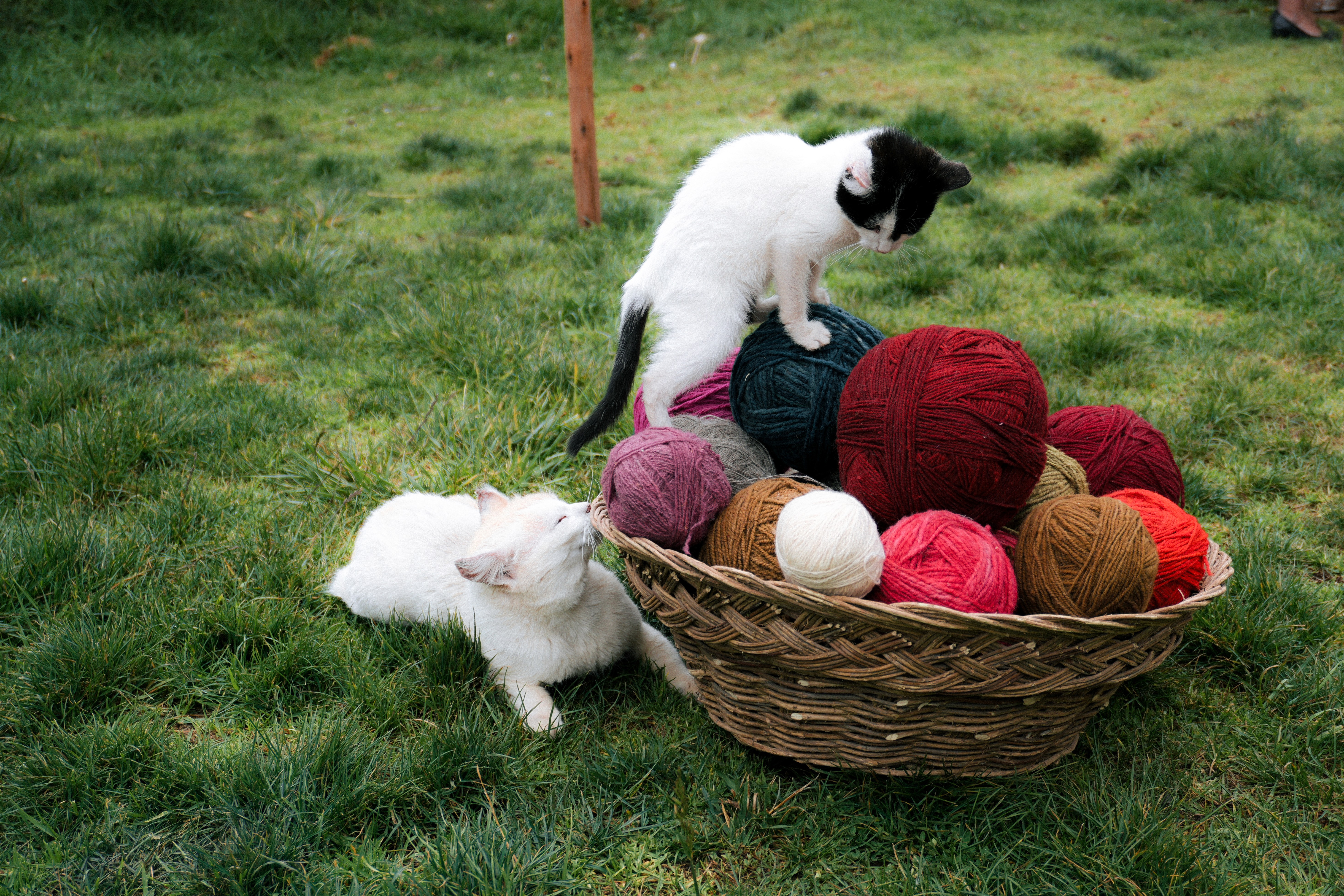
The space felt quietly alive. A dog lazily wandered across the yard, two cats — Coco and Lenteja — played with balls of yarn (how stereotypical, right?), and a couple of chickens scratched the ground nearby. Karen’s father was crouched beside a fire, heating water in God-knows-how-old ceramic pots, with natural ingredients that would soon become dyes all around him. Not far away, Karen’s mother, Erlinda, was laying out raw materials on the grass, preparing them for the different stages of the process.
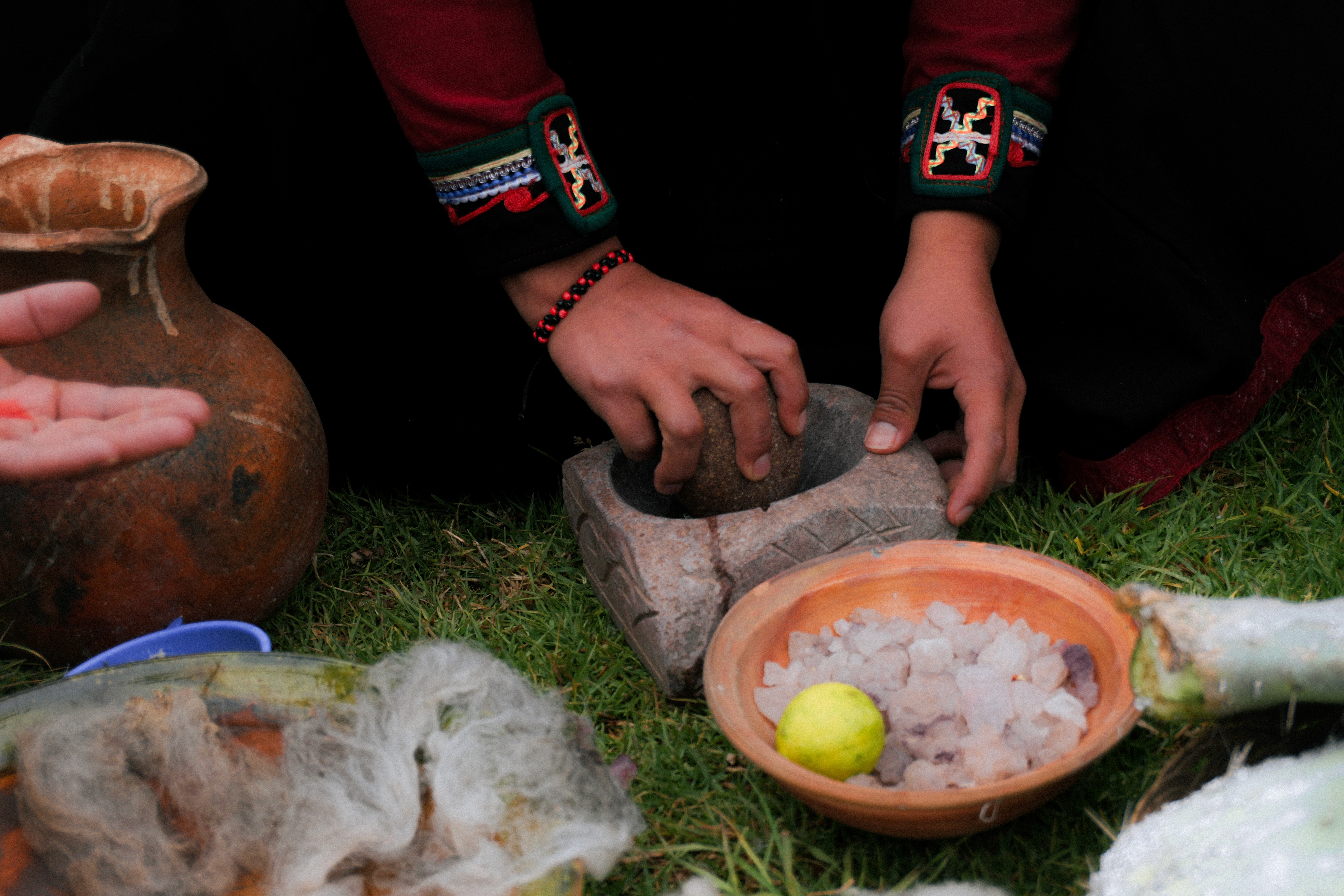
Everything begins with cleaning the wool. Freshly sheared fibres are naturally greasy and dusty, so they are washed using a soap made from the root of a local plant called saqta. When crushed and mixed with water, the root produces a surprisingly effective natural detergent.
Once the wool is clean and dry, it is spun into thread. Karen picked up a wooden spindle called pushka and, with a quick twist and constant motion, began transforming loose fibres into a smooth strand of yarn. The movement looked almost meditative, the kind of skill and mastery that can only come from doing the same thing thousands of times over the years. As captivating as it was, I couldn't yet stop thinking about how their way of sitting on the ground — all day, every day, for most of their lives — would have impacted their health in their later years. Soon enough I found myself deeply lost in my own mind, thinking about potential shapes for a back support system that could make their job a bit easier and their senior life a bit sweeter.
Then came the colours.
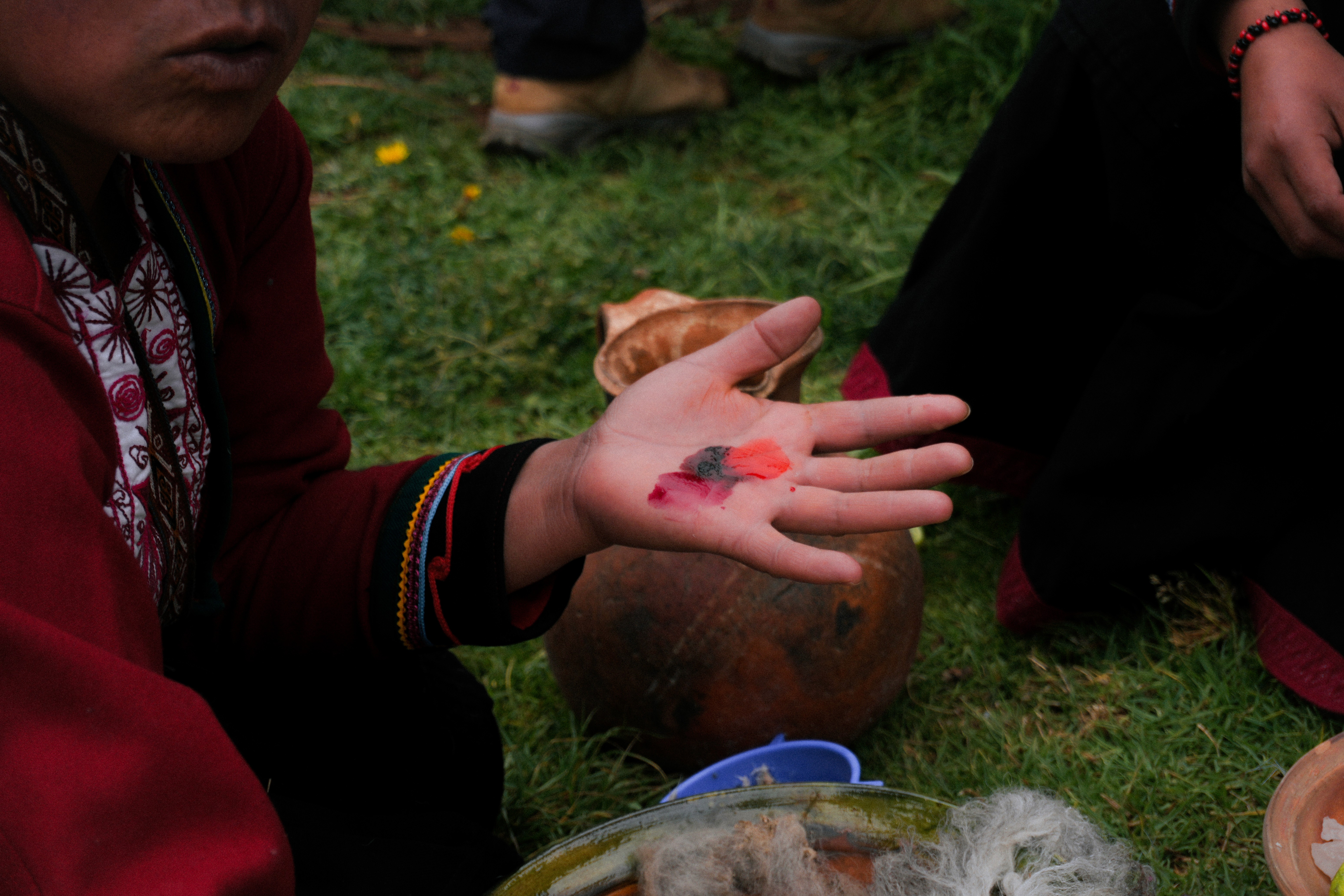
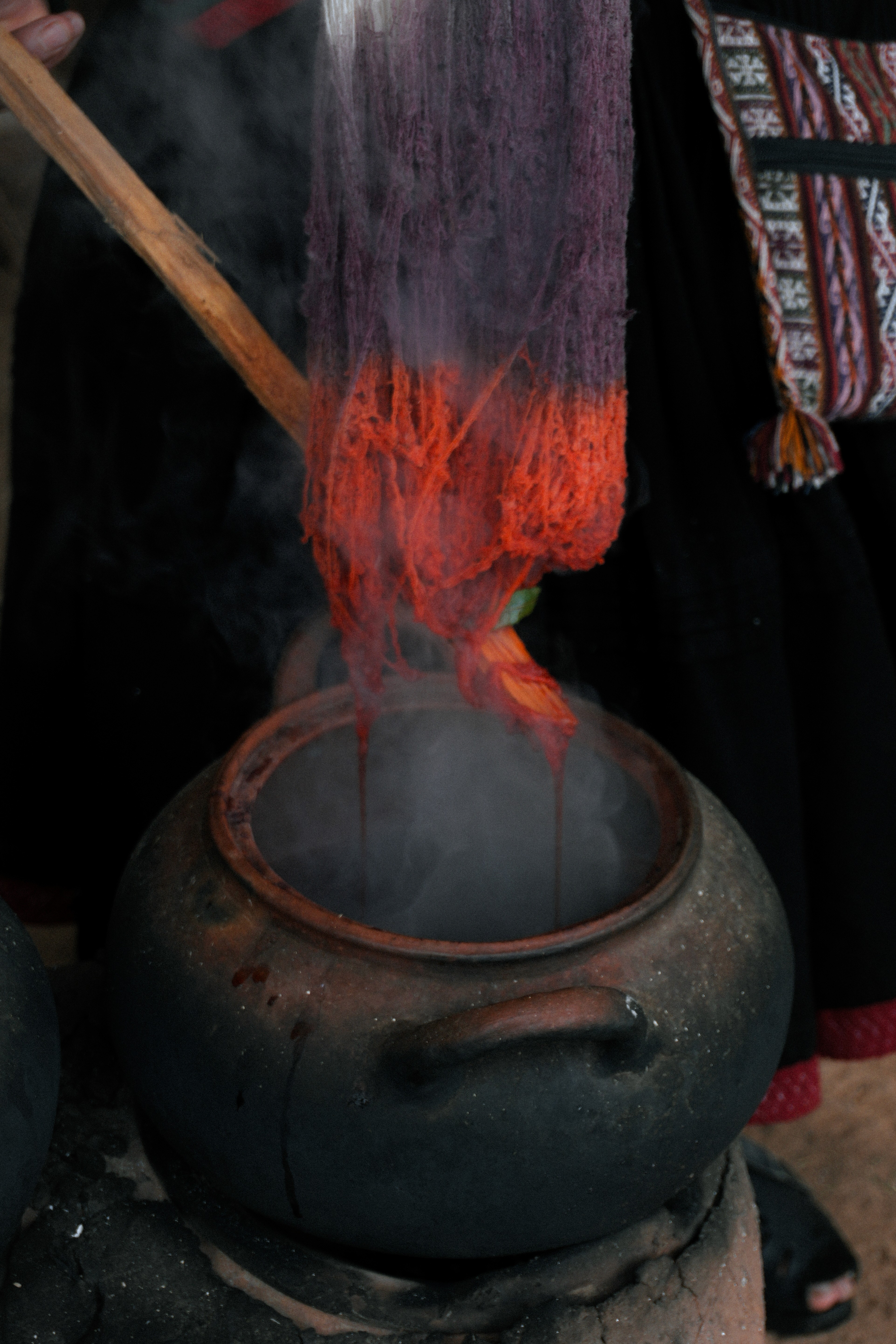
Karen showed me tiny grey insects called cochineal, which live on cactus plants spread across Peru, Bolivia, and parts of Chile. When crushed, they release a vivid red pigment that has been used in the Andes for centuries, especially by local women as a sort of bright natural lipstick. By mixing the crushed insects with different ingredients — lemon juice, salt, or minerals — the same dye can produce an entire range of colours, from bright pink to deep crimson and even purple. Other shades usually come from plants: flowers, leaves, and bark.
The wool, repeatedly dipped in her dad's old pots, slowly absorbed it all.
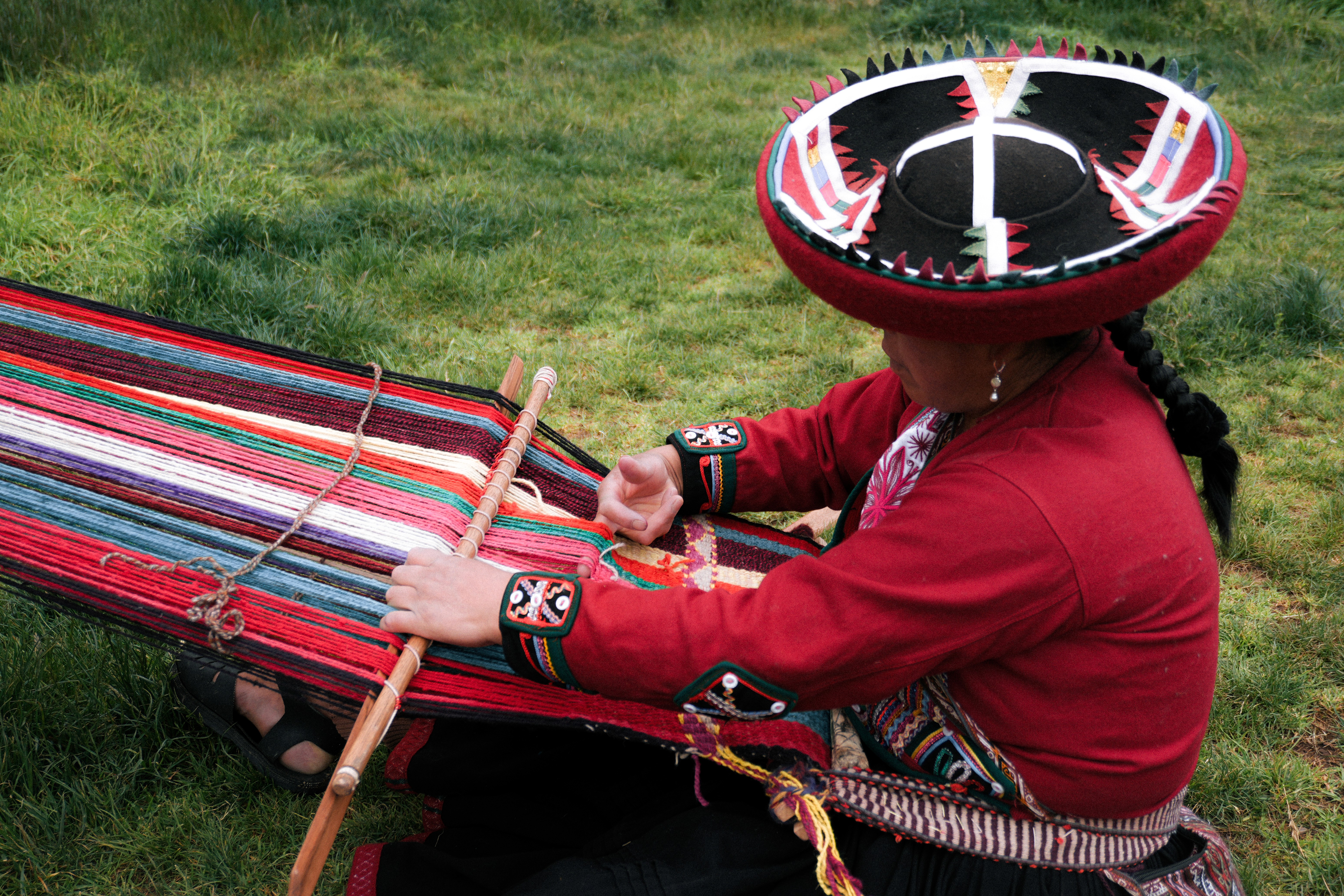
Finally, Karen and Erlinda demonstrated the weaving itself using a traditional backstrap loom. One end of the loom is tied to a fixed point (basically a wooden pole planted in the soil), while the other is secured around the weaver’s waist. By leaning forward or backward, they control the tension of the threads and gradually build the pattern. The loom itself looks almost deceptively simple — a few wooden sticks and cords — yet the textiles that emerge from it can take whole weeks, sometimes months, to complete.
After the demonstration we sat together for a while, talking about our lives, about Peru and about Europe, the kind of quiet conversation that happens naturally when time slows down.
Before leaving, I bought from the family a bright green and orange sheep wool blanket to take with me (after all, I had to bring it along for only two more months of travelling; who cares if it weighed 4 kilograms and wouldn't fit in any of my bags?). After inquiring about it, I was told it took four months to make, and that the repeated vivid pattern represented puma footprints. Karen explained the symbolism. In Inca tradition, the puma represents protection, bravery, and intelligence. It belongs to Kay Pacha, the earthly world, also known as the realm of the living. Together with the condor (sky) and the snake (underworld), the puma forms the Inca trilogy of sacred animals.
During my time in Peru, I became increasingly fascinated by how deeply the Incas embedded the natural world into their symbols. Mountains, animals, rivers, plants: these elements appeared everywhere in their art, their traditions, and their lifestyles as a whole. Nature isn’t just scenery, it was — and still is — central to how life itself is understood.
It reminded me of a quote from one of my all-time favourite movies, The Eight Mountains, inspired by Paolo Cognetti's eponymous book. When meeting his best friend’s peers for the first time, Bruno — a young adult who had spent all his life at high altitudes, and one of the protagonists — reproached one of them: "Only you city folks call them mountains. For us, they're woods, pastures, streams, rocks. Things you can point to. Things you can use."
I vividly remember this striking a note when I first saw the movie. Visiting Peru hit the same chord again, only this time with much more intensity and greater impact.
From a Western perspective, many of our cultural narratives place humans firmly at the centre of the story. To draw a comparison with another religion, in Christianity — whose cultural residues still have quite the influence over a significant portion of our planet — nature tends to appear only occasionally, sometimes beautiful, oftentimes destructive. Just think of when God sends a plague of locusts to punish the Pharaoh, or when Noah is cast as the ultimate protector and selector of the animals that had to be saved from the biblical flood. Which — if we really think about it — is kind of ironic, considering how some of those species have been on this planet much longer than humanity, and have withstood catastrophes whose scale of destruction we probably can't even fathom. Why would they ever need us to save them? Even if they needed saving, it's likely that we are going to be the ones they'll need to be saved from, not by.
Yet, watching Karen’s family transform the wool of their own alpacas into colours drawn from insects and plants, and then weave patterns representing animals and mountains, for maybe the first time I felt a different relationship with the world quietly revealing itself — one where humans are not separate from their environment, but deeply intertwined with it.
The weaving traditions of Chinchero — and Peru in general — are often presented simply as beautiful handicrafts for visitors, which they certainly are. But they are also something far more meaningful: a living archive of knowledge and perspective passed down through generations.
Every thread carries memory, every pattern tells a story, and preserving traditions like these is not only about protecting a craft. It is about protecting a way of seeing the world — one that reminds us we are not standing above nature, but somewhere deep inside it.
Other Articles
More to read